
Learning outcomes
The Master graduate in Physics at the University of Camerino, will be able to: possess a deep knowledge of classical and modern physics, and of the methods of physics as a whole; apply advanced calculus techniques, of both formal and numerical nature; model a great variety of natural phenomena and of technological problems; apply main and advanced experimental techniques, perform measurements in a completely independent way, and critically analyze data.
In particular, specialization in the following fields can be achieved: theoretical and computational physics of condensed and complex systems, material science and nanophysics (theory and experiments), applied and interdisciplinary physics (energy, environment), Quantum information and computation (theory and experiments), Quantum sensing and quantum technology platforms, fundamental interactions, nuclear, particle, and astroparticle physics, gravitation and gravitational waves (theory and experiments), , advanced spectroscopy and cosmology.
Assessment of learning outcomes
The assessment of the knowledge and abilities acquired in an educational activity is carried through the evaluation of a written and/or oral exam at the end of the educational activity. In the case of a laboratory activity, the final evaluation may involve also a practical test in the lab. The result of tests held during the course can also be considered. However, the participation to these tests is optional for the students and any negative result will not preclude admission to the final exam. Learning activities are evaluated by a mark out of thirty, with the possibility of the additional recognition of “lode” (with praise).
Admissions rules and entry requirements
Students possessing a three-year university degree or equivalent foreign qualification are eligible to register for the Master degree in Physics (“Laurea Magistrale in Fisica”). The student who wants to enrol to the Master in Physics must possess a good knowledge and understanding of:
- Classical physics
- Quantum physics
- Mathematical analysis
- Geometry and linear algebra
- Basic experimental techniques
- Use of basic computing systems and their application to data acquisition and processing.
Assessment of the personal preparation of eligible students
Students with an Italian bachelor's degree in Physics
Students not satisfying at least one of these conditions will have to afford a colloquium in order to be admitted to the Master.
Students who are about to earn a bachelor's degree in physics can register conditionally (“sub condicione”) for the master's degree in physics. The conditions are that by October 1 (beginning of the new academic year) the students must have obtained at least 165 credits, and that by April 15 (of the following year) the students should earn their bachelor's degree in physics.
Students with an Italian Bachelor degree in other disciplines
- Passed examinations corresponding to at least 70 credits in the field of physics (SSD FIS/01-08);
- Passed examinations corresponding to at least 30 credits in the field of mathematics and computer science (SSD MAT/01-09, INF/01, ING-INF/05).
All other students
A committee will select the candidates on the basis of their transcript of studies and, if deemed necessary, by an interview. The selected candidates will receive a pre-admission letter, necessary for getting VISA. The enrolment will be finalized upon arrival at Unicam, after an interview with the coordinator of the master's degree in physics.
Teaching organization of the Master Degree
Majors (since 2026-2027 academic year)
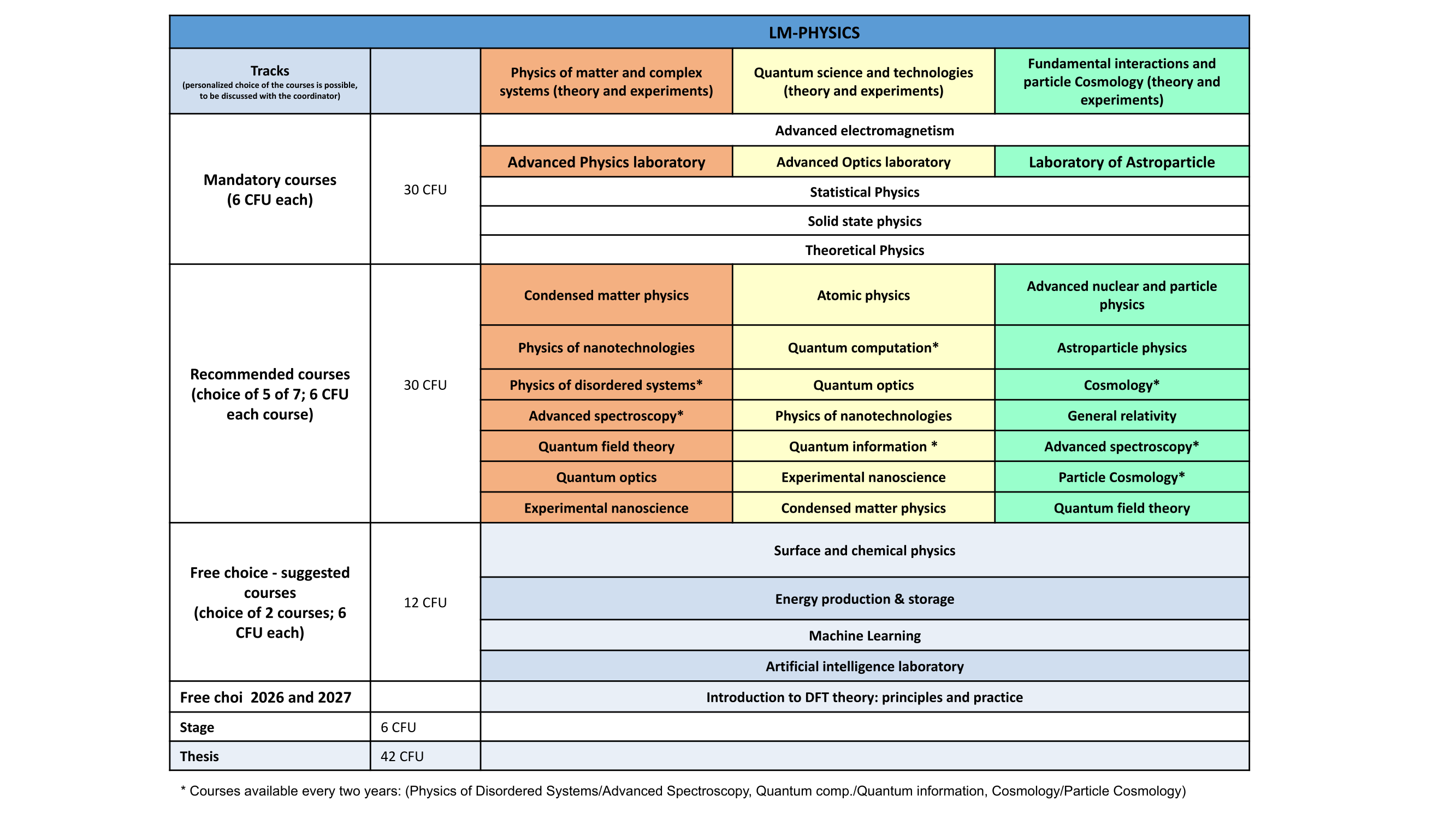
- Individual study plans can be proposed and must be discussed and approved by the coordinator
- Track A: Physics of matter and complex systems (theory and experiments)
topics:
-theoretical and computational physics of condensed and complex systems
-material science and nanophysics (theory and experiments)
-applied and interdisciplinary physics (energy, environment) - Track B: Quantum science and technology (theory and experiments)
topics:
-Quantum information and computation: theoretical and experimental foundation
-Quantum sensing and quantum technology platforms - Track C: Fundamental Interactions and particle Cosmology (theory and experiments)
topics:
-Theoretical, and experimental studies of fundamental interactions: nuclear, particle, and astroparticle physics.
-Classical and quantum field theories, gravitation and gravitational waves (theory and experiments), fundamental forces and cosmology.
-Observational and theoretical approaches to multi-messenger astronomy, advanced spectroscopy and sciences of the Universe.
Documento completo della commissione didattica
Majors (from 2022-2023 to 2025-2026 academic years)
Students enrolled from 2022 to 2025 are required to choose among the majors proposed below

- Individual study plans can be proposed and must be discussed and approved by the coordinator
- Astroparticle and nuclear physics
- Condensed matter and nanoscience
- Materials, Energy and Environment
- Quantum technologies
- Theoretical physics and complex systems
Last revision by A. Di Cicco in April 2026